Queer Places:
Lochland, 1065 Lochland Rd, Geneva, NY 14456
Peterboro Cemetery, Morrisville, NY 13408, United States
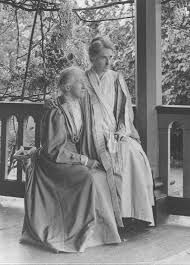 Anne Fitzhugh Miller (March 4, 1856 – March 1, 1912) was born in Peterboro, New York, on March 4, 1856. She was the youngest child and only daughter of Charles Dudley Miller
and Elizabeth Smith Miller, a women's suffragist in her own right and cousin to Elizabeth Cady Stanton. Elizabeth is well
known for designing and wearing an early version of the “Bloomer Costume” in the early 1850s. Anne had three brothers: Gerrit Smith, Charles Dudley, and William
Fitzhugh.
Anne Fitzhugh Miller (March 4, 1856 – March 1, 1912) was born in Peterboro, New York, on March 4, 1856. She was the youngest child and only daughter of Charles Dudley Miller
and Elizabeth Smith Miller, a women's suffragist in her own right and cousin to Elizabeth Cady Stanton. Elizabeth is well
known for designing and wearing an early version of the “Bloomer Costume” in the early 1850s. Anne had three brothers: Gerrit Smith, Charles Dudley, and William
Fitzhugh.
Named for her grandmother, Anne was the granddaughter of the prominent financier and abolitionist Gerrit Smith—suspected of being one of the “Secret Six” who financed
John Brown’s Raid on Harpers Ferry in 1859—and Anne Carroll Fitzhugh Smith. Both grandparents were active participants in the Underground Railroad, operating a home just
miles from the Canadian border and purchasing large tracts of land to provide homes and farms for runaway and freed slaves. "Silent Sentinel" member Edna Augusta Dixon was
also Anne’s Fitzhugh cousin.
In 1869, when Anne was thirteen years old, her family moved to Lochland, an estate in Geneva (Ontario County), New York. Her grandfather, Gerrit Smith, had established a
reputation for providing a welcoming refuge for 19th-century thinkers and reformers at his Peterboro estate. Her mother continued this tradition at Lochland, which quickly
became a cherished stopping place known for warm hospitality and stimulating conversation. Anne grew up immersed in this intellectual atmosphere and lived at Lochland for
her entire adult life, assisting her mother in maintaining its welcoming environment.
Elizabeth Cady Stanton was a frequent guest, spending six weeks there in 1883 after returning from Europe, several weeks in 1889 accompanied by two of her married
daughters, and a long visit in 1899 alongside Susan B. Anthony. Following 1899, both famous suffragists regularly spent summer
months at Lochland.
In 1875, Anne extended the family’s tradition by co-founding Camp Fossenvue on the eastern shore of Seneca Lake with her friend
Jane Ver Planck. Renowned reformer Max Eastman called the camp a “point of focus for the highest culture of the time.” In 1900,
Anne compiled and published memories of the camp in Embers from Fossenvue Backlogs.
Anne Fitzhugh Miller emerged as a prominent spokesperson for the suffrage cause at the New York State Constitutional Convention in 1894, where she delivered a powerful
speech advocating women’s suffrage. She attended nearly every state suffrage convention thereafter until her death and became recognized as one of Ontario County’s leading
figures in the movement.
Following the death of Anne’s father in February 1896, Elizabeth Smith Miller and Anne became a dynamic mother-and-daughter powerhouse in local and state suffrage
circles:
In 1897, Elizabeth persuaded the New York State Woman’s Suffrage Association to hold its annual convention in Geneva, with many delegates staying at Lochland. Inspired,
Anne called for a local political equality organization. The Geneva Political Equality Club (GPEC) was established on November 30, 1897, at the Geneva YMCA with 50 charter
members. Elizabeth served as honorary president, while Anne—initially reluctant—accepted the presidency in February 1899, holding the office until 1911.
Under Miller’s stewardship, the club thrived. By 1904, the state association proclaimed GPEC had acquired the most new members of any local club, and by 1907, membership
neared 400, making it the largest Political Equality Club in the state.
Miller used GPEC as a model to establish the Ontario County Political Equality Association in 1903, serving as its president until 1907.
Anne also held official roles within the New York State Woman’s Suffrage Association and actively participated in broader campaigns:
She attended an 1899 suffrage hearing before the State Judiciary Committee in the New York Senate Chamber and aggressively advocated for women taxpayers' voting rights
during legislative committee hearings in 1902, 1903, 1904, and 1905.
She represented New York State at a U.S. Senate hearing regarding a federal woman suffrage constitutional amendment in February 1906.
In 1909, she famously chided Theodore Roosevelt for stating that although he supported women’s suffrage, he did “not regard it as a very important matter.”
In 1907, when the state convention returned to Geneva, Elizabeth and Anne hosted a porch memorial service at Lochland for the late Mary S. Anthony.
Blessed with the financial means to support their convictions, the Millers were renowned for their philanthropic generosity:
Following Susan B. Anthony's death, a subscription fund raised $60,000 by May 1907, featuring $1,000 from Elizabeth and $500 from Anne.
In 1910, they contributed $300 to support the Washington State suffrage amendment.
Following the founding of William Smith College in Geneva, Miller endowed the institution with $2,000, instructing that the interest fund tuition for women students from
Geneva.
In 1910, Anne scaled back her GPEC activities to care for her ailing mother. Following Elizabeth’s death in May 1911, Anne resumed public life, delivering a speech in
September 1911 at the dedication of a public fountain donated to the town by her late mother.
Anne died in Boston on March 1, 1912, and is buried in the family plot at Peterboro Cemetery in Peterboro, New York.
References:
- Miller NAWSA Suffrage Scrapbooks, 1897–1911 (National American Woman Suffrage Collection). A 7-volume collection compiled by Elizabeth Smith Miller and Anne Fitzhugh Miller documenting the Geneva Political Equality Club, local reform networks, and correspondence. This includes specific documentation referencing local community circles, meeting notices, and correspondence involving the Herendeen family (such as letters by or concerning Mrs. William L. Herendeen and communications directed to the Geneva News by Anne Herendeen).
- National Park Service (NPS) & Women's Rights History: Biographies and institutional histories detailing the Smith-Miller family lineage, Gerrit Smith’s estate in Peterboro, NY, and the historic Lochland estate in Geneva, NY.
- National Park Service (NPS) & Women's Rights History: Documentation on Camp Fossenvue (founded 1875) on Seneca Lake as an early intellectual and recreational women's community.
Support this project
This website is a passion project researched, developed, and funded entirely by me. If you find the content valuable and would like to help support the ongoing research and hosting costs, any contribution is deeply appreciated.
Thank you for keeping this independent resource alive!
My books on Amazon: Elisa Rolle's books
BACK TO HOME PAGE